Huang, S., Xu, Y., Zhang, L. et al. A Shakedown Strength Based Parametric Optimization Technique and Its Application on an Airtight Module. Chinese Journal of Mechanical Engineering 35, 81 (2022). https://doi.org/10.1186/s10033-022-00750-z
Background and objective
Aerospace engineering increasingly needs several satellites or landers to share one launch vehicle while reducing launch cost, which makes lightweight structures essential. Reusable spacecraft further reduce the cost of space travel, but their structural reliability also demands more suitable assessment criteria and design methods.
Complex spacecraft components often develop highly non-uniform stress fields. Conventional design based on the elastic limit and relaxation factors can therefore be overly conservative: local yielding does not necessarily mean that the entire structure has lost its load-bearing capacity, while keeping all stresses well below yield can produce an unacceptable mass penalty.
The study proposes a parametric structural optimization method and numerical framework founded on shakedown analysis. The objective is to release more of a structure’s strength-to-weight potential without compromising load-bearing safety, while also providing a basis for durability assessment.
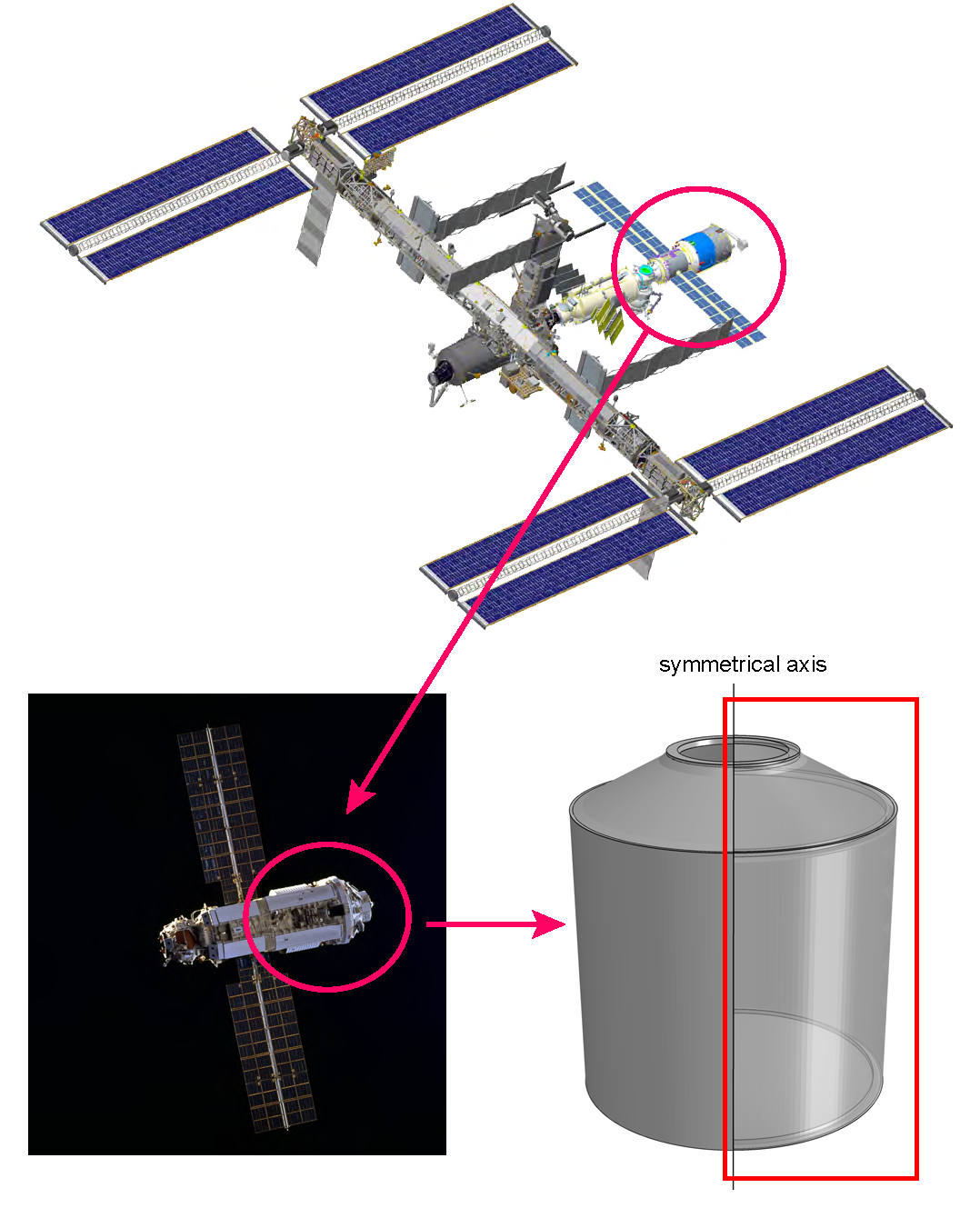
Method
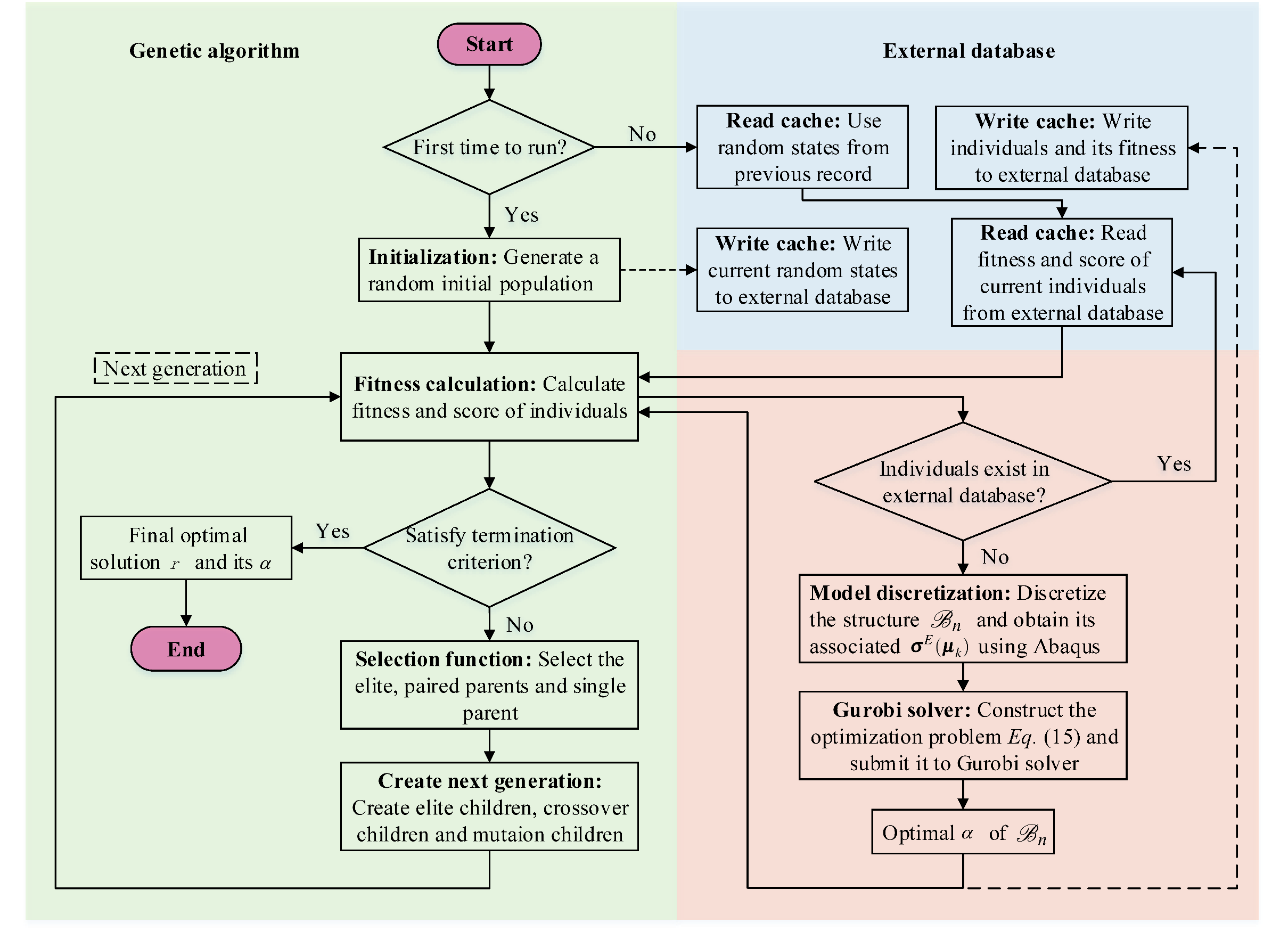
A nested two-level numerical framework is constructed. The inner loop uses an interior-point method to calculate the structural shakedown limit for a fixed set of parameters. The outer loop searches for the parameters that maximize either the shakedown limit or the shakedown-strength-to-weight ratio.
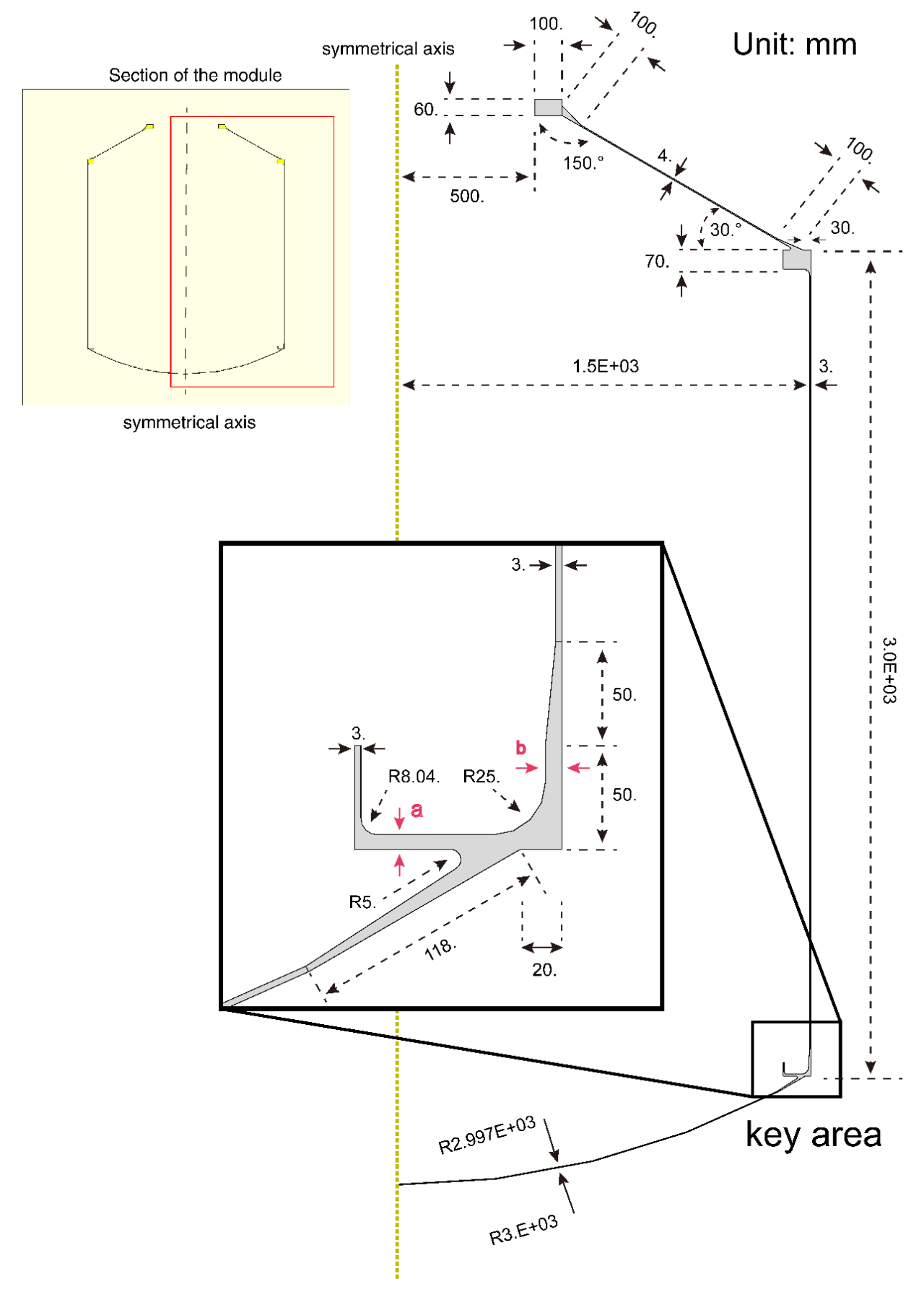
The process begins with population initialization, evaluates fitness through shakedown analysis, builds an intermediate database, checks the stopping condition, generates a new population, and re-evaluates individual fitness. A benchmark perforated-plate problem verifies the method before it is applied to determine key parameters of a crewed airtight module. The study compares designs based on elastic, plastic, and shakedown limits as well as strength-to-weight efficiency.
Main results
- The perforated-plate benchmark verifies the effectiveness of the proposed optimization workflow.
- The fitted response surfaces for the airtight module’s elastic, plastic, and shakedown limits are strongly nonlinear. The elastic-limit surface lies well below the shakedown-limit surface, showing that elastic design does not fully exploit material load-bearing capacity.
- For design parameters a < 8 mm and b < 7.5 mm, increasing either parameter raises structural strength. Beyond those values, elastic and shakedown limits tend to saturate while the plastic limit continues to rise slowly.
- When maximum shakedown load is used as the objective, a scattered initial population gradually converges, with the individuals almost completely overlapping by the twentieth generation.
- Designs optimized for shakedown load and shakedown-load-to-mass efficiency reduce maximum equivalent stress and displacement relative to the initial design. The design with the lowest equivalent stress, however, is not necessarily the design with the greatest load-bearing capacity.
Conclusions
- Shakedown analysis can replace a purely elastic criterion in spacecraft structural design because it reflects actual load-bearing capacity more objectively.
- The shakedown limit can respond non-monotonically and nonlinearly to geometric parameters, especially in complex structures. A genetic algorithm helps avoid slow convergence and local optima that can affect gradient-based outer-loop optimization.
- Although the reported study considers two design parameters and one objective, the numerical framework can be extended to multi-parameter and multi-objective engineering optimization.
Outlook and application
The shakedown-based framework can maximize structural strength-to-weight potential while maintaining safety and can also support durability assessment. It is therefore promising for spacecraft and other structures that demand further lightweighting under repeated or variable loads.
Songhua Huang is the first author of the featured paper. At the time of publication, his research focused on plastic limit and shakedown analysis and their applications in structural optimization.